What it’s like to live in north Baltimore, one neighborhood at a time
“North Baltimore” isn’t a town or an official district. It’s what people call the neighborhoods in the northern part of Baltimore City. Here’s what each one is actually like: the houses, the streets, what’s nearby, and what living in the city means for your taxes and services.

Updated November 2026
The short version
I live in Lake Evesham and I sell homes across these neighborhoods, so this is the guide I’d give a friend. The north Baltimore neighborhoods sit roughly between the Jones Falls valley on the west, York Road on the east, the Baltimore County line on the north, and Johns Hopkins University’s Homewood campus on the south. Most of the housing was built between the 1890s and the 1940s, and almost every neighborhood here grew up around a streetcar line or a planned development. That history is why the streets look the way they do.
| Neighborhood | ZIP | Built mostly | Main home types | Covenants or association review |
|---|---|---|---|---|
| Roland Park | 21210 | 1890s to 1920s | Large detached Victorians, shingle-style, Colonial Revival, Tudor | Yes |
| Homeland | 21212 | 1924 to 1940s | Detached Colonial Revival, Georgian, Tudor | Yes |
| Guilford | 21218 | 1913 to 1930s | Detached Georgian Revival, Tudor, colonial, some French and Italian styles | Yes |
| Lake Evesham | 21212 | 1920s, some older | Bungalows, foursquares, revival-style homes | No formal covenants; National Register district |
| Cedarcroft | 21212 | 1910 to 1939 | Dutch Colonial, Federal and Tudor Revival | Yes |
| Hampden | 21211 | 1830s to 1920s | Brick rowhouses, stone mill houses | No |
| Charles Village | 21218 | About 1895 to 1915 | Porch-front rowhouses, some split into apartments | No, but a special benefits district |
Roland Park
Roland Park was begun in 1891 by the Roland Park Company, with street and landscape planning from the Olmsted Brothers firm. It’s one of the country’s early planned suburbs, built along the streetcar line on Roland Avenue. The streets curve with the hills, the lots are generous, and the houses are big: Victorian and shingle-style homes with deep porches on the older east side, and Colonial Revival and Tudor homes as you move west.
The Roland Park covenants, written into deeds when the neighborhood was built, still apply, and the Roland Park Roads and Maintenance Corporation collects fees and enforces them. Day to day, you’ve got the Roland Park shops on Roland Avenue, the Stony Run trail along the stream valley, and Lake Roland a short drive north over the county line. Several private schools have campuses here, which shapes school-hour traffic on Roland Avenue and Charles Street.
Homeland
The Roland Park Company bought the Perine family farm in 1924 and built Homeland with the Olmsted Brothers again shaping the plan. The Perines had dug a chain of ponds in 1843, and the developers kept them. Today “the Lakes” run through the middle of the neighborhood with curving roads along the water. The homes lean traditional: brick and stone Colonial Revival, Georgian and Tudor designs, mostly detached, built from the mid-1920s into the 1940s.
Every Homeland property is subject to the 1924 Deed and Agreement, and the Homeland Association enforces it, so exterior changes go through review. Belvedere Square’s market and restaurants, the Senator Theatre and the York Road corridor are on the east edge, and Charles Street runs along the west.
Guilford
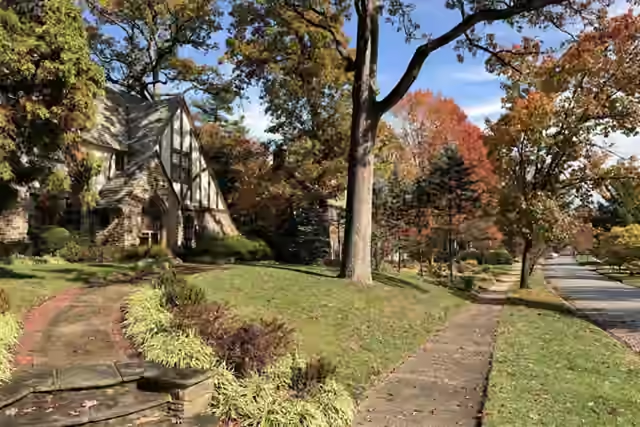
Guilford was built on the former estate of A.S. Abell, founder of The Sun, starting in 1913. Frederick Law Olmsted Jr. laid out the streets and small parks. The houses are mostly detached and substantial: Georgian Revival, Tudor and colonial, with some French and Italian influenced designs mixed in. Mature trees cover nearly every street.
The heart of the neighborhood is Sherwood Gardens, a privately maintained park that’s open to the public and known for its spring tulips. The Guilford Association enforces the original Deed and Agreement covenants. Guilford sits between Charles Street and Greenmount Avenue, close to Johns Hopkins’ Homewood campus and the Baltimore Museum of Art.
Lake Evesham
This is my neighborhood, so I’ll be specific. Lake Evesham is about 250 homes between Bellona Avenue and York Road, just inside the city line. It was carved out of a larger estate in the late 1800s, but most of the houses went up in the 1920s as builders followed the York Road streetcar north. The result is a mix: bungalows, foursquares, revival-style homes and a few older farmhouses, many with detached garages in back.
The Maryland Historical Trust describes the narrow roads with stone-lined gutters and old-growth trees, and that’s still what it feels like. Lake Evesham was listed on the National Register of Historic Places in 2003. Belvedere Square and the Senator Theatre are a short walk east. I serve as Vice President of the Lake Evesham Community Association.
Cedarcroft
Cedarcroft is Lake Evesham’s next-door neighbor, bounded by Gittings Avenue, York Road, East Lake Avenue and Bellona Avenue. The Cedarcroft Land Company built most of it between 1910 and 1939, and the city’s historic preservation office describes the houses as Dutch Colonial Revival, Federal Revival and Tudor Revival. The streets are narrow and lined with trees that arch overhead.
The Cedarcroft Maintenance Corporation carries the original covenants forward, and owners submit plans and color choices before changing a house’s exterior. Cedarcroft was listed on the National Register in 2003.
Hampden
Hampden started as housing for workers at the cotton and flour mills along the Jones Falls. Some of the oldest homes, stone mill houses from the 1830s to the 1860s, still stand near the old mills in areas like Stone Hill. Most of Hampden is brick rowhouses built as the neighborhood filled in through the late 1800s and early 1900s, many of them renovated now.
The commercial center is West 36th Street, which everyone calls The Avenue: independent shops, restaurants and bars. Hampden hosts HonFest in June, and the 700 block of 34th Street lights up every December. Several old mills along the Jones Falls have been turned into offices, apartments and restaurants, and the Jones Falls Trail runs below the neighborhood. Parking is on the street on most blocks.
Charles Village
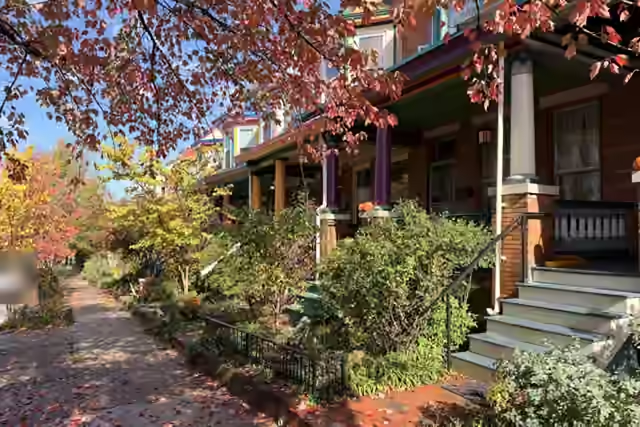
Charles Village is mostly rowhouses built from about 1895 to 1915, many with front porches, bay fronts and small front gardens. Some blocks are known as the Painted Ladies, after neighborhood painting contests in the 1990s left facades in bold colors. Larger rowhouses near the Johns Hopkins Homewood campus have been converted to apartments over the years, so you’ll see owner-occupied homes and rentals side by side.
The Baltimore Museum of Art, Wyman Park and the Homewood campus are here, and the Waverly farmers market runs on Saturdays just east. Charles Village is a special benefits district: owners pay a surcharge on their property tax that funds extra sanitation and community services.
Just over the county line: Rodgers Forge, Anneslie and Towson
A Baltimore, MD 21212 mailing address doesn’t always mean Baltimore City. Rodgers Forge and Anneslie sit just north of the city line in Baltimore County, and Towson is the county seat a little farther up York Road. That line changes your property tax rate, your public schools and your county services.
- Rodgers Forge: about 1,777 brick rowhouses built by the Keelty company between 1931 and 1957, in English and Early American styles, with community architectural covenants.
- Anneslie: a 1922 grid of streets east of York Road with Tudor, Cape Cod, colonial and foursquare homes, named for an 1850s estate house that still stands.
- Towson: the county seat, home to Towson University and a mix of rowhouse, colonial, ranch and condo neighborhoods.
City basics: taxes, schools and getting around
Baltimore City’s real property tax rate is $2.248 per $100 of assessed value for fiscal 2026, compared with $1.10 in Baltimore County, according to the Maryland Department of Legislative Services. On a home assessed at $400,000, that’s about $8,992 a year in the city before credits, versus about $4,400 in the county.
Baltimore City Public Schools assigns elementary schools by address, and middle and high school involve a choice process. Look up any specific address with the school system before you count on a particular school.
I-83 runs down the Jones Falls valley to downtown, Northern Parkway crosses east to west, and Charles Street and York Road run north to Towson. The light rail stops at Woodberry, Cold Spring Lane and Mount Washington on the west side.
Want the numbers behind these neighborhoods? Read north Baltimore neighborhoods compared by home type and the cost of living in north Baltimore on my main site, or browse the neighborhood guide.
Questions people ask
Is North Baltimore its own city?
No. North Baltimore is the everyday name for the neighborhoods in the northern part of Baltimore City, including Roland Park, Homeland, Guilford, Lake Evesham, Cedarcroft, Hampden and Charles Village. They’re all inside the city limits and pay Baltimore City taxes.
What neighborhoods are in north Baltimore?
The ones people mean most often are Roland Park, Homeland, Guilford, Lake Evesham, Cedarcroft, Hampden and Charles Village, plus neighbors like Lake Walker, Remington, Evergreen, Wyndhurst and Bellona-Gittings. There’s no official boundary, so usage varies.
Is Towson part of north Baltimore?
No. Towson, Rodgers Forge and Anneslie are in Baltimore County, just north of the city line. Some of those homes have Baltimore, MD mailing addresses, which confuses people, but county homes pay county property taxes and are served by Baltimore County Public Schools.
How much higher are property taxes in Baltimore City than Baltimore County?
For fiscal 2026 the city rate is $2.248 per $100 of assessed value and the county rate is $1.10, per the Maryland Department of Legislative Services. That makes the city rate roughly double before any tax credits.
Do Roland Park, Guilford and Homeland have HOAs?
Not in the usual sense, but each has deed covenants from when it was built, and a neighborhood corporation or association enforces them. Exterior changes generally need review, and Roland Park also has road maintenance fees. Cedarcroft has a similar maintenance corporation.
Which north Baltimore neighborhoods have rowhouses?
Hampden and Charles Village are mostly rowhouses, and so is Remington. Roland Park, Homeland, Guilford, Cedarcroft and Lake Evesham are mostly detached homes, with some semi-detached houses mixed in.
How do I find out which public school serves a house?
Use Baltimore City Public Schools’ school finder with the exact address, and confirm with the school system. Assignment depends on the address, and middle and high school involve a choice process.

About Mike Fielder
Mike Fielder is a Baltimore Realtor and Sales Director of The Key Home Team at Cummings & Co. Realtors. Licensed since June 2016, he focuses on North Baltimore (Lake Evesham, Lake Walker, Cedarcroft, Hampden and Remington) and the Towson area. He also serves as Vice President of the Lake Evesham Community Association.
Over his career, Mike has sold 190 homes worth more than $56 million. He’s backed by The Key Home Team, which has sold more than $375 million in real estate and closes about $30 million a year.
Mike founded Property Management of Baltimore in 2014, two years before getting his license, and still runs it. Managing rentals taught him what repairs really cost, which updates buyers pay for, and how to keep a deal moving when something breaks. Sellers get that judgment when deciding what to fix before listing. Buyers get it when they’re reading an inspection report.
A Towson University graduate, Mike keeps his approach simple: price from real recent sales, spend money only where it pays back, and compare offers by what the client actually keeps.
More from Mike: Neighborhood guide · North Baltimore ZIP codes · Full bio
Trying to pick the right north Baltimore neighborhood?
Tell me what kind of house you want, your budget and where you need to get to, and I’ll show you which streets fit. I live here, so ask me anything.
The Key Home Team of Cummings & Co. Realtors
Cell: 410-905-6678
Email: [email protected]
Office: 410-823-0033
108 W Timonium Rd, Timonium, MD 21093
Website: mikesellsbaltimore.com